
A Transformative Journey into the Heart of Sustainability.
R.K. Nair
In a world struggling to balance growth and sustainability, R.K. Nair stands as a beacon of hope. Known today as the “Green Hero of India,” he has dedicated his life to transforming barren, lifeless land into thriving green ecosystems — and inspired thousands along the way.
But this title wasn’t given — it was earned through decades of relentless work, silent sacrifice, and a deep spiritual connection to nature. With no official position in government or any backing from major environmental bodies, R.K. Nair started his journey with a single goal: to heal the Earth with trees.
The Man Who Turned Dust into Forests
What makes R.K. Nair extraordinary is his ability to see possibility where others see problems. In Nargol Village, Gujarat, he built the world’s largest Miyawaki forest, where over 1,20,000 trees now grow densely along the sea. This forest was planted using the Japanese Miyawaki method — a technique that creates fast-growing, self-sustaining native forests in just a few years.
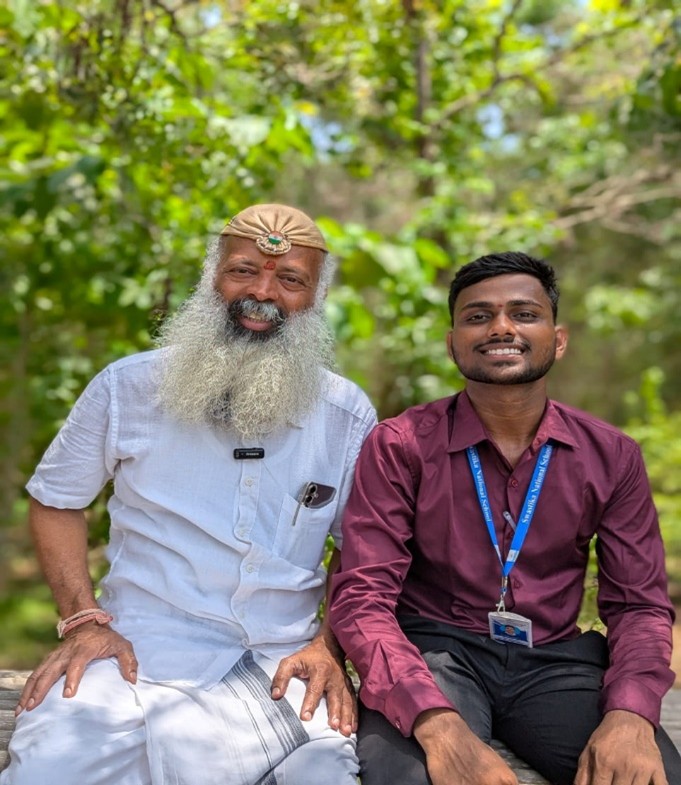
Not far from there lies Amrit Van, another green miracle. On a piece of land that was once salt-affected, barren, and considered “waste,” he created a lush forest of over 75,000 trees. The soil was dead. The water was salty. But his belief was strong — and the trees answered.
These are not just plantations. They are living forests, complete with birds, insects, biodiversity, and a new microclimate. In places once silent and cracked by drought, you now hear the rustle of leaves, the hum of life, and the song of revival.
Why He Is the Green Hero of India
R.K. Nair is called the Green Hero of India because:
- He has converted over hundreds of acres of dead land into thriving forests.
- He has planted more than 2 lakh trees through his projects — many in areas declared “unsuitable” for vegetation.
- He practices zero chemical use, and revives soil and groundwater through natural methods.
- He is a self-driven leader, without waiting for awards, applause, or funding.
- He inspires the next generation of environmental stewards through hands-on involvement and personal mentorship.
In a time when deforestation, climate change, and pollution threaten our future, R.K. Nair is proof that one person, with vision and action, can make a national impact.
Meet of R.K Nair
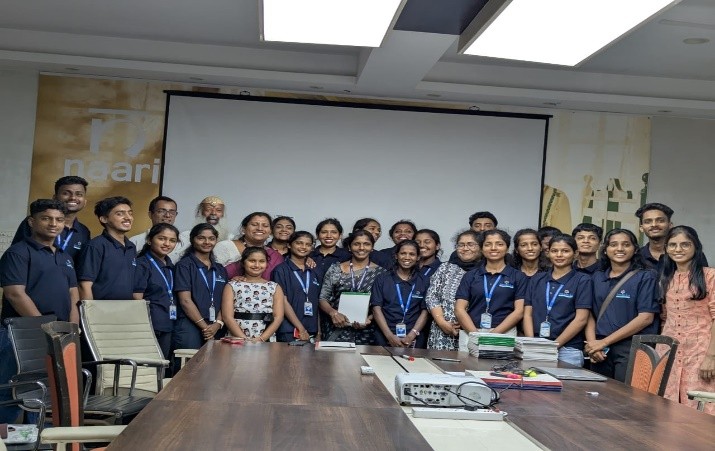
A group of enthusiastic students from Swastika National Business School recently returned from a meaningful and eye-opening three-day educational trip to Gujarat, guided by the vision and hospitality of renowned forest creator R.K. Nair. The visit was a result of an unexpected but wonderful opportunity—when Mr. Nair noticed our team at a press meet in the Mangaluru Press Club, he was impressed by our energy and invited us to witness his green initiatives in Gujarat.
A group 24 members left Mangaluru on May 1, 2025, and reached Gujarat by train on May 3, ready for an experience that would change our outlook on sustainability forever.
Day 1: From Factories to Forests
Our first stop was Aura Green, a factory known for making pure and natural chips. Here, we learned how local raw materials are turned into healthy snacks using eco-friendly processes. It was eye-opening to see how a business could operate with both quality and sustainability in mind.
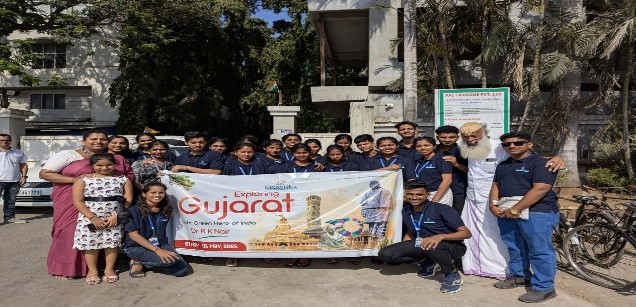
Next, we visited Pal Fashion Ltd., where we got a glimpse of how a large-scale garment manufacturing unit functions. It gave us a new appreciation for how fashion and industry align with ethical practices.
But the highlight of Day 1 was our visit to Navapur Village, where we walked through a beautiful forest developed from scratch by R.K. Nair Sir. What was once barren land is now home to thousands of trees, birds, and biodiversity. It was truly inspiring to see the impact one person’s vision can make.
Day 2: Standing Among Giants – The Miyawaki Forest
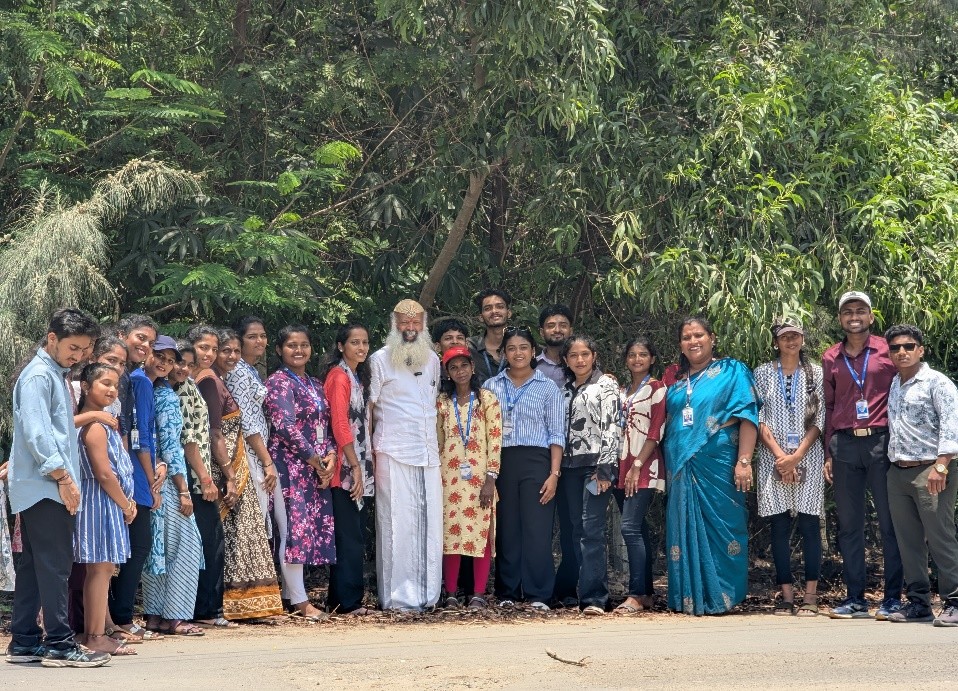
On the second day, we visited the world’s largest Miyawaki forest, located near the sea in Nargol village, Valsad district. This coastal green zone, with over 1,20,000 trees, is a living example of what consistent care and dedication can achieve. Standing among the tall trees, we could feel the power of nature reclaiming its space.
Miyawaki Method
- The benefit of Miyawaki Technique, a unique methodology proven to work worldwide, irrespective of soil and climate conditions.
- Approximately 30times more trees planted, as compared to conventional plantation techniques.
- A minimum of 300% more species in the same area as compared to conventional plantation species.
- A substantial 3000% increase in noise and dust isolation.
- Up to 30 times or more Carbon-dioxide absorption as compared to conventional forest.
- Guaranteed growth of at least 1 meter every year, in tree height.
- A completely maintenance free, wild and native forest after the first three years.
- A completely chemical-fertilizer free forest that sustains itself and supports local bio-diversity.
Why Adopt Miyawaki Method
- Selection of plant species based on soil climate and usage; plantation.
- Customised modem day plantation that can be modified and inserted in everyday spaces available around us
- No maintenance required after 2 years; biodiverse plantations enabling ecosystems of birds and butterflies.
Later, we headed to Daman to relax at the scenic beach, soaking in the sea breeze and reflecting on everything we had learned so far. It was a perfect blend of learning and leisure.
Day 3: Planting Hope for Tomorrow
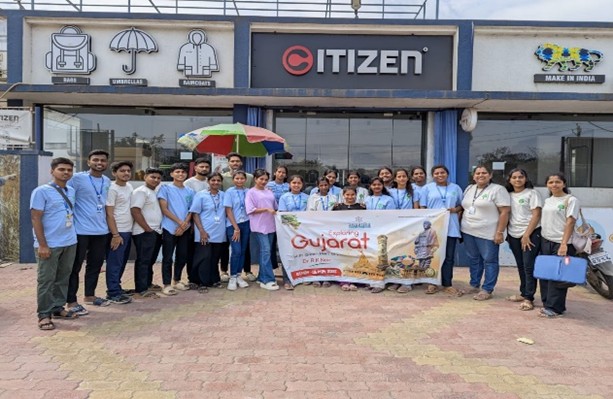
We started our third day with a visit to Itizen, a bag manufacturing unit that creates eco-friendly products. From there, we visited Ayyappa Temple and Nagabana Temple, seeking blessings for our journey and upcoming plantation drive.
The main highlight of Day 3 was our visit to Amrit Van, a forest grown on previously barren, salt-affected coastal land. With over 75,000 trees, Amrit Van is a living example of how nature can heal itself when given a chance.
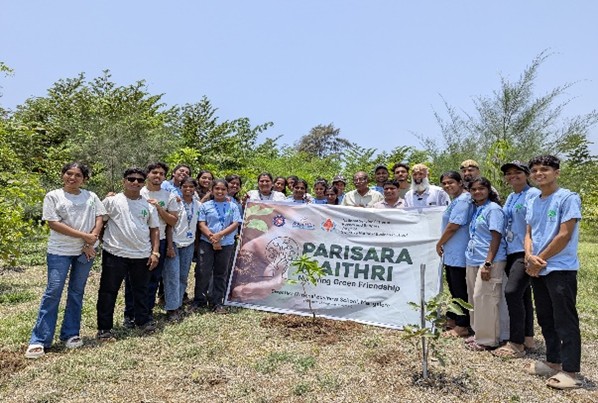
Together, under the guidance of R.K. Nair Sir, we planted mango saplings that we had brought all the way from Mangaluru. Planting those trees with our own hands was not just symbolic — it was personal. It felt like we were leaving behind a small part of ourselves in that land.
A Journey to Remember
We ended the trip with a little shopping before heading back to Mangaluru on the night of May 6. The entire experience was nothing short of magical. We didn’t just learn about sustainability — we lived it.
We are incredibly thankful to R.K. Nair Sir for his generous hospitality and for showing us how one person’s mission can lead to a massive environmental impact. His life and work have inspired each of us to think differently about our role in protecting the planet.
This journey was organized under the combined efforts of the NSS, Rangers and Rovers, and Parisara Maitri units of Swastika National Business School. Thanks to their coordination and dedication, we were able to participate in something far bigger than ourselves.
This was more than just a study tour — it was a journey of the heart, mind, and spirit. We came back not just with memories, but with a mission: to plant more trees, spread awareness, and continue the green legacy we were lucky enough to witness.